
The following Table shows the differences in the positions of notes in a Saptak, as obtained by North Indian Pt. Bhatkhande and South Indian Pt. Sreenivas, when they attempted to fix the positions on the string by 'hearing' the notes on the string. (Refer to table in the image below).
There have been other research workers too, and their values for 22 Shrutis have been already mentioned in Topic 6.
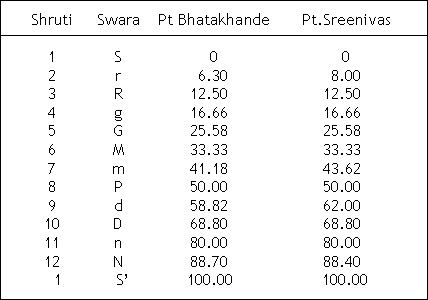
Table shows the % differences in frequencies of Shrutis as found by 'hearing the string' experiments done by Hindustani Classical Music Pundit Bhatkhande and Karnatak Classical Music Pundit Sreenivas.
The lesson of this experiment was loud and clear, that the Shruti positions can never be fixed by 'hearing', because, at any given time, two musicians will have a different perception of Shrutis in their brain.
The possibility of such a difference will exist irrespective of the caliber of musicians.
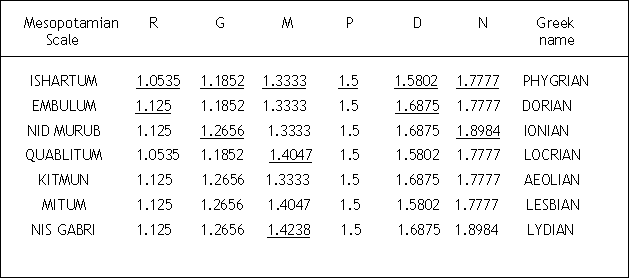
In a footnote, 39, on page 373 of Harry Partch's Genesis Of A Music, Partch relays:
"Ellis observes, (Journal of the Society of Arts, 33:489, 490) that
Indian treatises "ostentatiously eschew arithmetic" and adds that "some musicians, like the
Indians, repudiate all measurement and all arithmetic from the first, and leave everything to
the judgment of the ear." Up to a certain point, of course, arithmetic and an acute ear accomplish
exactly the same results."
………………………………………………………………………………………………….
Mr. Ellis was unaware that the exact 22 shrutis of Indian music (as calculated by Dr. Oke) were nicely illustrated by extending the central Duodene shown in his just intonation Duodenarium, by 5 notes contiguously above and 5 notes contiguously below the 12 notes of the Duodene. There in a neatly symmetrical array are the 22 shrutis!
I think Dr. Oke's work will vindicate the musical legacy of Bharat, which has suffered many disparaging slights in western accounts of musical history.